You've talked to therapists, coaches,
and friends.
Talking out problems gives you insight.
But insight hasn't changed what you do.
- ✓ 60-minute live session
- ✓ A desensitization exercise built for you
- ✓ Keep the recording. Train on your own.
- ✓ Get targeted next steps you'll actually do
- ✓ 20-minute follow-up debrief included
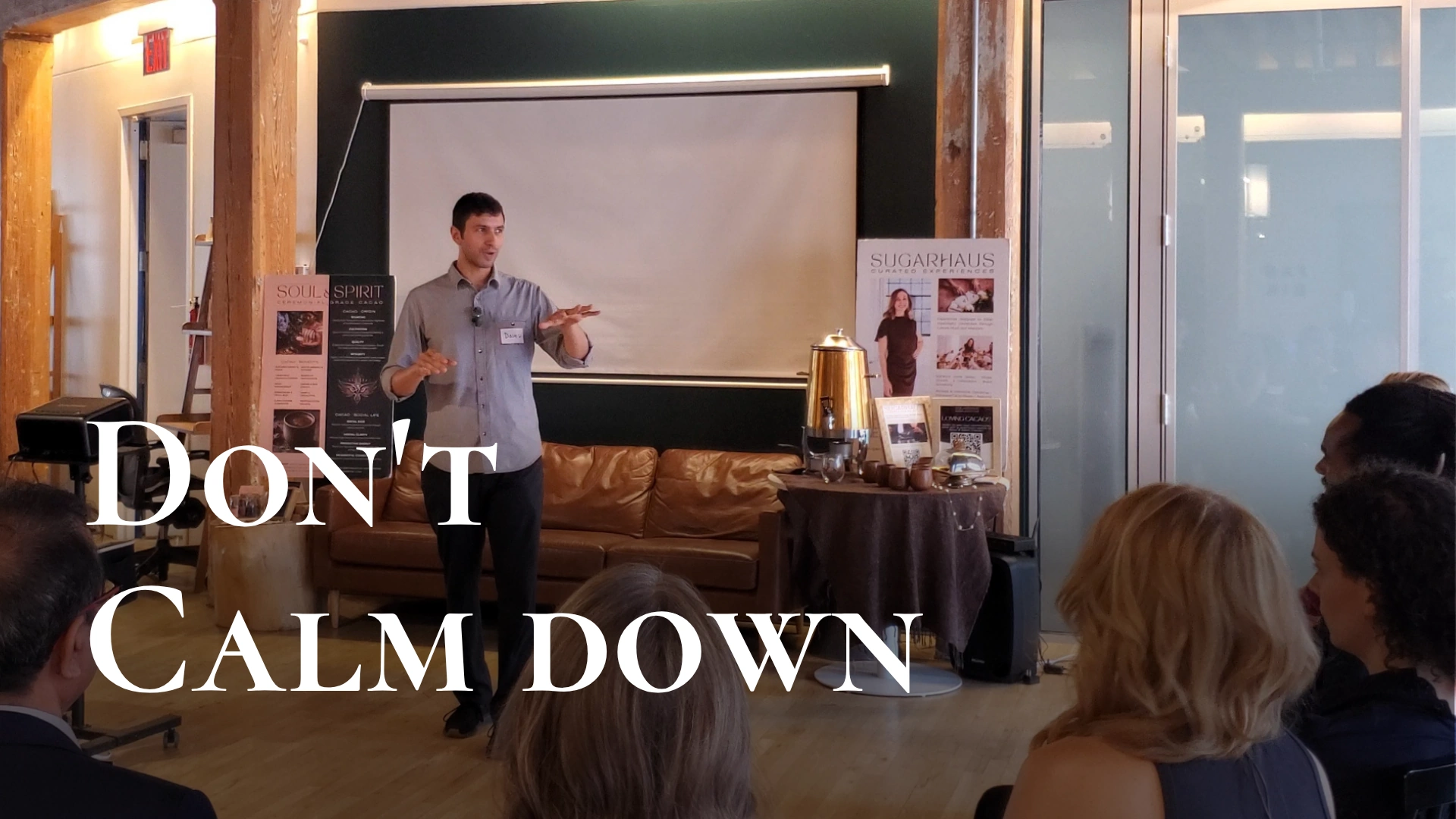

"I've gained so much clarity, focus, and balance from Dave's sessions. If you're looking to reduce stress, I highly recommend him!"
Wade Bailey, Project Manager · ★★★★★ LinkedIn ↗
You've told this story before.
You tell it well.
To a therapist. To a coach. To a friend at dinner who really got it. You know where the pattern came from, you know why it makes sense, and you can describe it more clearly than most people could describe anything about themselves. And you're still not doing the thing.
Explains the pattern. Where it came from, what it protects, why it made sense.
Change the feeling. The action still runs through something your body treats as a threat.
That's not a discipline problem, and it isn't because you haven't understood yourself well enough. Understanding is information. Avoidance is a nervous system doing its job. Information doesn't reach it.
Here's the proof, and it's new: you can now get a sharp, patient, well-framed reading of your problem at 2am, for free, from a machine that never gets bored of you. If insight were the bottleneck, that would have solved it. Notice that it didn't.
Something else has to loosen it.

"Dave helped me better than anyone so far. I am wicked ADHD and dozens of times I have tried to develop both AM and PM routines. Gotten farther than any previous attempt so far."
Larry Brown, CPA & Business Owner · LinkedIn ↗
What clients say
about Dave's coaching.
Tiffany K. from KY
I understood it completely.
It didn't help.
I was 25, standing in front of 50 parents, presenting on topics I knew inside out — math, psychology, the brain. I had prepared. Rehearsed. I knew my material.
And I was shaking.
I could also explain exactly why. I knew the story: if I'm too nervous, I'm gonna blow it, so I can't be nervous, so I have to stop being nervous. I could have written you a paragraph about where that came from and what it was protecting.
None of that helped. I still scanned the room to see if they could tell. I still lost my thread mid-sentence. The nervousness made me less coherent, which made me more nervous. Understanding the loop did not stop the loop.
One day, walking to a presentation, I noticed the feeling in my stomach. And for the first time I recognized it. This is the same feeling I have every single time. Before both the wins and the losses.
Years of mindfulness practice kicked in that moment. Instead of running from it, I leaned in and listened to it. Oh. There you are. My pre-presentation feeling. I know you.
That took the energy out of it. Not because I'd understood something new — I hadn't. Because I'd stopped bracing against the sensation and let it be there. That's a different move than thinking, and it's the one that changed what I could do.
There's a mechanism behind this. The principle is the same one that makes exposure work: repeated, tolerable contact with a feeling you've been avoiding reduces how much charge it carries. Mindfulness-based approaches are built on it — you turn toward the sensation instead of away, and the link between sensation and threat gets weaker. Movement raises BDNF* and modulates the amygdala's threat response, which is why we move first. I studied this at Columbia — M.S. in Neuroscience & Education — and I've spent years building a process that gets there faster than it took me.
*Brain-derived neurotrophic factor: brain chemical that increases learning, memory, and higher thinking. It helps brain cells form new connections.
Move. Meditate. Make.
Two things happen in the room. One happens in your life. Together they're a loop, and the loop is what produces change.
Move
A few minutes of light movement to get your heart rate up. Nothing athletic. This primes your nervous system to learn — you can't desensitize a body that's sitting still and defended.
Meditate
I guide you into the exact feeling we just spent half an hour finding — built live, from your words, not a generic track. You stay with it instead of leaving. Then it's recorded, and it's yours.
Make
You pick one experiment to run before we talk again. Small, specific, real. Then we look at what actually happened and adjust. That's the part that compounds.
A session is a fraction of a percent of your life. It only matters if it changes what you can do in the rest of it. That's what the third step is for.
Your pattern.
Your custom experience.
We find the specific feeling standing between you and the thing you're not doing. Then I take you into it, on purpose, in a way you can tolerate — and you leave with the recording and one experiment to run.
What people say
about Dave's work.
"Dave's greatest impact was on my job performance. If you procrastinate, if you have impostor syndrome — Dave is the guy for you."

"Dave helped me gain clarity in my hang-up around charging for my services. He has you stop and breathe — so you can speak from a place of groundedness."

"I came out of our session with great insight and a solid action plan tailored to my needs."

"Working with Dave was one of the best coaching experiences I've ever had."

"Thanks to his support, I've become more confident in my personal value and brand."

"Dave provided exceptional service and a profound understanding of what I was actually dealing with."

"Dave helped me better than anyone so far. I am wicked ADHD and dozens of times I have tried to develop both AM and PM routines. Gotten farther than any previous attempt so far."
"Working with Dave was phenomenal. He helped me channel my skills into a workable and realistic plan."

"Working with Dave was one of the best things I did for my career. His approach was super collaborative."

A few quick answers.
We talk first, and we're looking for something specific: the feeling that shows up right before you don't do the thing. Then a few minutes of light movement, then a guided visualization and meditation I build live around what you just told me. It's targeted at your exact pattern, not a generic relaxation track. You leave with the recording and one experiment.
Different job. Therapy tends to work on the roots — where the pattern came from, what it means, how it connects to your history. That's real work and I'm not competing with it. Several of my clients are in therapy and we're doing different things. My work is on the state: what your body does in the moment, and how to change what you're able to do while it's happening. They feed each other well.
No. I'm a coach, not a therapist, and I don't treat clinical phobias or trauma. But the underlying principle is the same one exposure is built on: repeated, tolerable contact with something you've been avoiding reduces the charge it carries. I apply that to ordinary avoided actions — the pitch, the ask, the boundary, the rest — not to clinical conditions. If what you're dealing with belongs with a licensed clinician, I'll say so.
That's fine, and it's common. You usually don't need to arrive with a diagnosis — you need to arrive with a situation where something keeps not happening. We find the pattern in the first half of the session. Bring the thing you're avoiding, not a theory about why.
The opposite. If you already know the action, we skip the part most coaching spends its time on and go straight to what's in the way. Knowing what to do and not doing it is the specific situation this is built for.
One session creates a real shift, and you'll feel it before you leave. But desensitization works through repetition — your nervous system learns the way a muscle does. Plenty of people take the recording and keep training on their own. For people who'd rather be walked through it, there's The Cognitive Performance Year: unlimited sessions for 12 months. We'd talk about it at your debrief, and your $180 is credited toward it.
Full refund on the session, no questions asked.
One hour.
Then go do the thing.
$180 for the session, the recording, and the debrief. You've understood this long enough.
Book My Breakthrough Hour